

Flavour, Not SKU Codes: Designing 4700BC's Shopify Catalogue for Discovery
How we made new flavours, gifting ranges and collaborations easier to find without slowing the next launch.

Executive Summary
How we made new flavours, gifting ranges and collaborations easier to find without slowing the next launch.
Step 1 before step 1 - Improving Navigation
You know what can really improve customer navigation? Its when a website is built keeping navigation in mind instead of building a website around products. Businesses naturally organise products around internal information: SKUs, suppliers, warehouse groups and reporting categories. Shoppers organise them around a decision.
For 4700BC, those decisions could include:
What flavour do I feel like eating?
Do I want popcorn, chips, nachos or a mixed bundle?
Is this for everyday snacking, a party or a gift?
Am I looking for a bestseller or a new release?
Do I want an individual pack or something to share?
Navigating these questions are already hard enough and honestly sometimes feels like a chore, so why should there be an extra step between the decision making and purchase decision?
Nobody has the time or patience these days to do market research on popcorn of all things. The entire process from hopping on the website for the very first time to finding what you need to checking out has to take place without any friction. The navigation system we built had to answer all of the questions and more because the customer does not need to understand the product database to find a snack.
The overly simple solution that wasn’t as simple? Build and group the cataolgues around the most useful discovery routes. Then we decided which attributes belonged in navigation or filters, and which should remain in the product data.
Data is only useful if someone can use it.
Look at what brands like Blinkit have done with their most recent updates. Their search functionality has been redesigned in such a meaningful way that even if people enter random keywords, a product will always display. The search query does not come back with the error “No Product Found.” In one meaningful update, they have tackled the issue of typos as well product recommendations.
Now, obviously this is a fairly new feature built to tackle 1000s of products. We needed to implement a similar solution with two limiting factors
1. 4700BC was a Shopify website, so there are some natural limitations that come to it as opposed to building your own app from the ground up.
2. The products needed clear distinction and that could only work through filters.
Filtering works only when the underlying data is consistent. "Cheese," "Cheesy," and "Cheese Flavour" may look close enough to a person, but a storefront can treat them as three unrelated values.
While filters are awesome and we all love them, the big challenge when it comes to having filters that actually make a difference is standardisation across the board. Things that we often overlook are really what customers use as a point of reference/ search. Looking at the website and navigation journey from their lens really helps open a new perspective.
Using this new found perspective, we immediately understood how the whole standardisation flow needs to happen. We first standardised started with flavours.
Since flavours are likely to be the highest decision making factor when it comes to a food brand, we started fixing that. Identifying the main flavours, grouping them into several different moods before moving on to the other main factors.
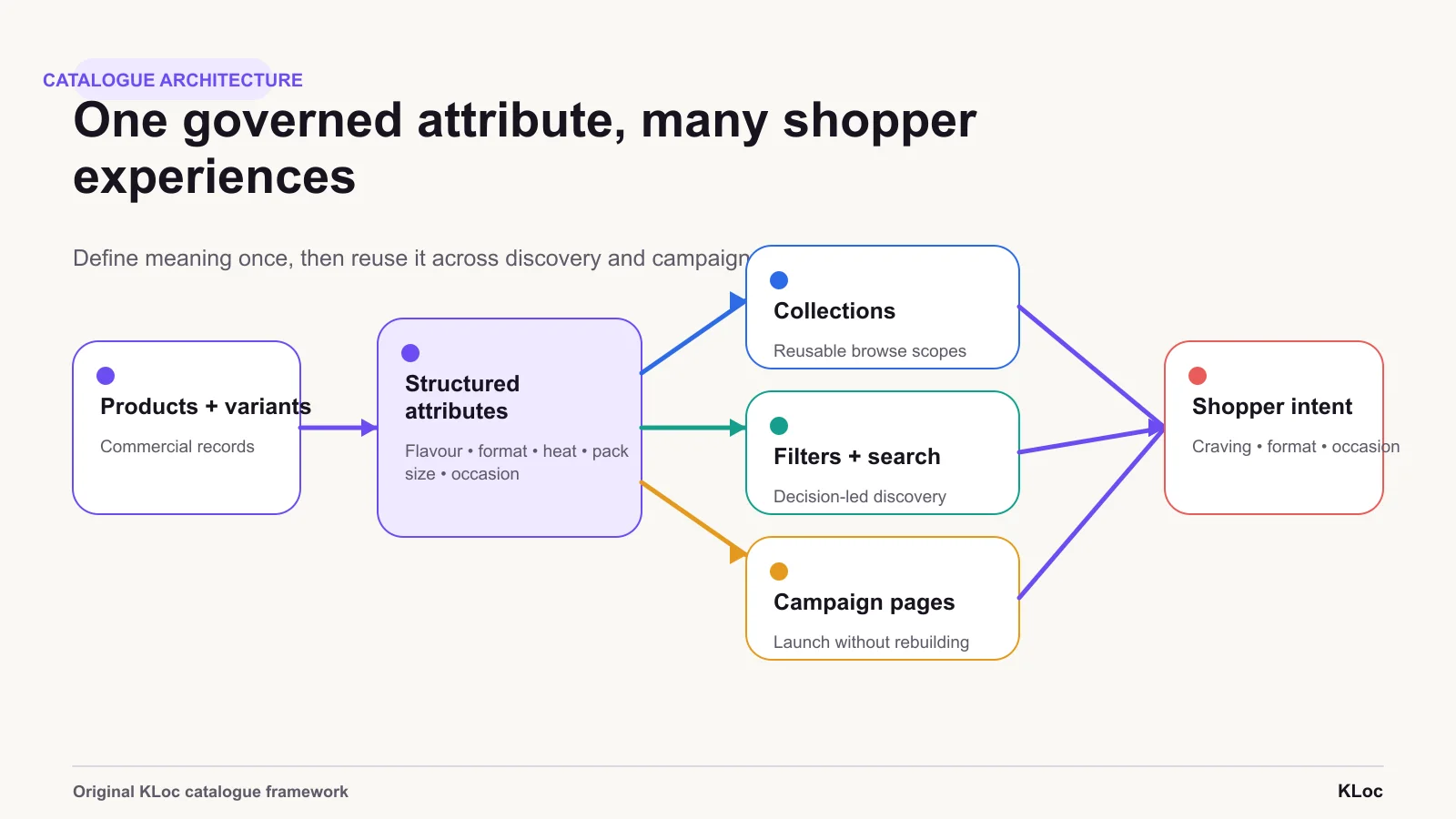
Formats, occasions and other useful attributes vary across the range and that’s where our focus moved to next. Shopify collections handled the larger browsing destinations, while we structured product data powered filters, merchandising and reusable content.
The refined data model effectively empowered product cards to carry more weight. Within an expansive catalogue, a single card must provide sufficient context for a shopper to determine if a product warrants a closer look. Critical details—ranging from flavour profiles and snack formats to pricing and stock status—should be immediately obvious, removing the friction of excessive clicking.
Baymard Institute's recent UX analysis highlights a common pitfall: half of all benchmarked ecommerce sites fail to strike the right balance of information in their listings. This imbalance often leads customers to bypass ideal items or forces them into a cycle of manual investigation. Ultimately, the priority is not the volume of results on a screen, but the speed at which a shopper can evaluate each individual choice.
If it repeats, why complicate it? Make repeat launches repeatable
For a company as active as 4700BC, frequent launches are something that are part of its product offerings. Launches are always exciting, whether its a new product or new campaign, it doesn’t matter. What does matter is that it is a special time for any company, and having a reliable system means one less headache to worry about.
Frequent launches need a repeatable system. Rebuilding the storefront for every campaign would slow the brand down and just increase unnecessary costs.
By building reusable digital frameworks, we ensured the 4700BC team could deploy and merchandise fresh ranges without reinventing their process. This allows a new collaboration to maintain its unique narrative and aesthetic while still leaning on the storefront's proven navigation and conversion logic.
However, every campaign needs a clear retirement strategy. Without strict rules for seasonal or limited editions, expired offers and duplicate collections quietly accumulate. This digital clutter eventually erodes search accuracy, complicates navigation, and diminishes the shopper's trust in the brand.
To keep operations lean, we recommend generating temporary campaign collections from existing attributes. This lets the team layer on specific copy and merchandising without disrupting the primary catalogue. Launch efficiency should be tracked via internal project logs to ensure data remains grounded in reality.
Why mobile needed stricter editing
Mobile browsing intensifies these friction points. Limited screen real estate means filters can feel intrusive, essential product details are easily obscured, and scrolling through endless, repetitive lists becomes a digital chore.
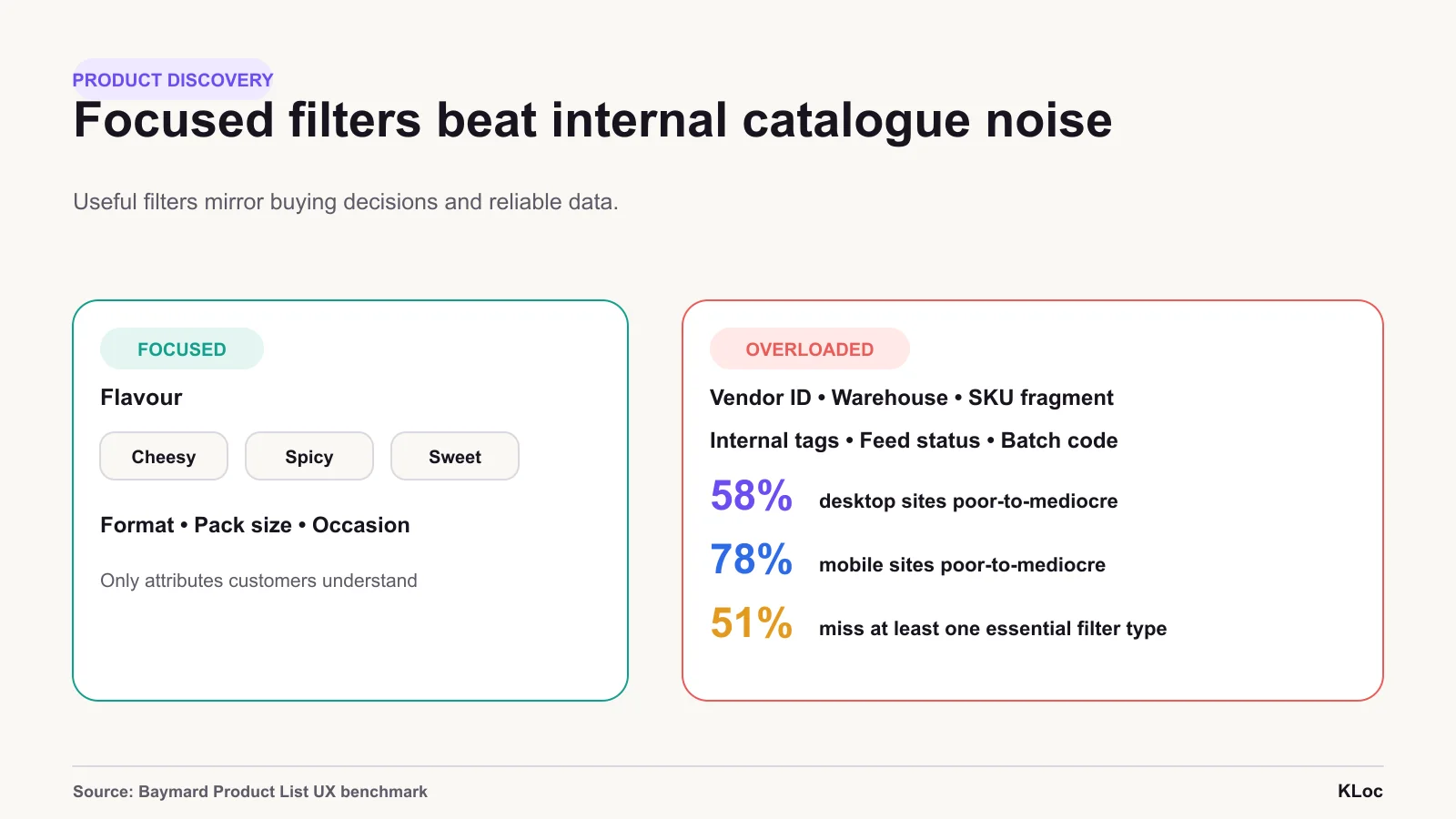
Recent data from the Baymard Institute suggests a widespread struggle: 58% of desktop platforms and 78% of mobile storefronts fail to deliver a high-quality product-listing experience. Furthermore, half of benchmarked sites overlook at least one critical filtering category essential for customer decision-making.
The solution isn't to overwhelm the shopper with every possible option. While Shopify supports up to 25 active storefront filters, surfacing all of them creates unnecessary noise. The goal is to curate only the attributes that mirror actual purchase criteria, stripping away anything that doesn't aid the final choice.
For 4700BC, prioritizing intuitive discovery routes ensures that a vague craving transforms into a satisfying purchase without the customer feeling like they are performing data entry.
A catalogue the team can keep changing
By reimagining the site architecture, we provided shoppers with more intuitive paths to explore while equipping the brand team with a scalable blueprint for deploying future ranges and seasonal activations.
The operational insight is clear: a disciplined data model transforms catalogue management from a manual chore into a repeatable system. While specific performance metrics require verified analytics, merchants should focus on improving search accuracy, minimizing dead-end queries, and reducing the time spent on manual merchandising.
Expansive catalogues often fail when they prioritize backend logistics over the psychological triggers of a snack run.
The most effective discovery systems maintain breadth without creating noise. When every choice is easy to evaluate, variety becomes a brand strength rather than a source of digital clutter.
If your growing collection is becoming a hurdle for your customers, the KLOC team can help audit the data structures and navigation logic that might be obscuring your best-selling items.
Sources: Baymard's 2025 product-list research, product-card information research, and Shopify filtering documentation.
Governed attributes
One governed attribute can power several customer experiences. Define meaning once and reuse it consistently across navigation, filters and product content.
Filter logic
Useful filters mirror buying decisions and reliable catalogue data. Baymard figures describe its benchmark, not 4700BC performance.
The right team for
the work ahead.
Share the brief, the context, or the challenge. We respond within one business day.
Division 01 · KLOCOM
Commerce Engineering
Shopify Plus builds, migrations, integrations, managed services, and agentic commerce architectures.
Explore KLOCOMDivision 02 · KLOCAPPS
Custom Software
Web and mobile applications, platforms, enterprise integrations, and applied AI products built to last.
Explore KLOCAPPSDivision 03 · KLOCERS
Technology Talent
Senior individual engineers, delivery pods, and embedded engineering teams shaped around your systems and delivery brief.
Explore KLOCERS