

How to Hire a Shopify Agency Without Paying for the Same Store Twice
A practical buyer's scorecard for evaluating an agency's proof, process, people and post-launch responsibility.

Executive Summary
A practical buyer's scorecard for evaluating an agency's proof, process, people and post-launch responsibility.
Write the brief before you make the shortlist
An unclear brief produces proposals that are impossible to compare.
Before contacting an agency, define:
The business problem, not merely "we need a new website"
The outcomes that should change
The project type, markets, channels and languages
Critical systems such as ERP, WMS, PIM, CRM or subscriptions
A budget range and meaningful target date
The decision-maker and what must be true three months after launch
You don't need to prescribe every feature, but the agency does need enough context to separate requirements from wishlist items.
Relevant evidence beats an impressive logo wall
A beautiful fashion store is weak proof for an ERP-heavy B2B migration. A large logo is weak proof if the agency delivered only one campaign component.
Ask for two or three examples with comparable risk:
Similar catalogue or order complexity
Similar migration source
Similar integrations
Similar international, B2B or team constraints
Ask what the agency did, who did it and how it was measured. "Conversion increased" without a baseline and timeframe is marketing copy, not evidence.
Check Shopify credentials, then look beyond them
Shopify's Partner Directory categorises service partners into Select, Plus, Premier and Platinum tiers. The old "Shopify Plus Partner program" branding ended in December 2024.
Directory standing is a qualification signal, not a guarantee of fit.
Shopify says eligible Partner Directory reviews connect to merchant collaborations involving collaborator access. Read beyond the average score for recurring comments about communication, ownership and post-launch work.
KLOC's official directory profile currently shows a 4.9 rating from 621 reviews and a relationship with Shopify dating to March 2015. That is more useful evidence than a generic "trusted expert" badge.
Meet the people who will do the work
The sales team may not be the project team.
Before signing, meet the likely delivery, technical and UX leads, and the migration or integration owner where relevant.
Ask each person about a difficult project decision. Listen for how they reason, explain trade-offs and respond to incomplete information.
Clarify which roles are employees, partners or subcontractors. Outsourcing is not inherently wrong; undisclosed dependency is.
Evaluate the process through real questions
Use questions connected to your actual risk:
How will you validate requirements and control scope changes?
What does your QA matrix cover across devices, markets and customer types?
How will you protect organic traffic during migration?
Who owns redirects and post-launch monitoring?
How are architecture and integration decisions documented?
What happens if an application cannot support a required edge case?
What access is required, and what is the launch escalation plan?
Which work will our team own?
A good answer names artefacts, responsibilities and decision points. A methodology name alone tells you very little.
Compare proposals using a weighted scorecard
The lowest price may reflect a different understanding of the scope.
| Dimension | Suggested weight | What to examine |
|---|---|---|
| Relevant results and references | 25% | Comparable projects, measurable outcomes, reference conversations |
| Technical fit | 20% | Architecture, integrations, migration, performance and security experience |
| Process and communication | 20% | Discovery, reporting, change control, QA and escalation |
| Delivery-team seniority | 15% | Actual people assigned and their availability |
| Commercial clarity | 10% | Assumptions, exclusions, payment schedule and change rates |
| Post-launch support | 10% | Warranty, SLAs, monitoring, training and roadmap |
Score independently before discussing as a group, so presentation style does not overwhelm evidence.
Check ownership before signing
The contract should explain:
Who owns custom code and design files, and where they are stored
Whether you receive repository and deployment access
Who pays for themes, apps and third-party tools
Which components are licensed rather than owned
How credentials, documentation and training are handled
What constitutes a defect after launch
Critical-issue response times and exit arrangements
You should not depend on one supplier merely to access your own storefront.
Red flags that deserve attention
Guaranteed performance without a measurement plan
A fixed proposal before meaningful discovery
Refusal to introduce delivery-team members
Portfolio examples with no explanation of the agency's role
No SEO migration or redirect responsibility
No documented QA approach
Integrations called "plug and play" without validation
Unclear app, theme or code ownership
No post-launch support model
Every recommendation happens to be something the agency sells
Do they improve the question?
The best partner will improve the initial question, identify unnecessary work and expose missed risks. That may mean recommending a smaller project, a standard Shopify plan, an existing application or no rebuild at all.
A good agency shows judgement instead of pretending to have every answer. Choose the team whose thinking you want beside you when the plan meets real customer behaviour, legacy data and operational constraints.
That is the team least likely to make you pay for the same store twice.
Use this scorecard to compare the teams, evidence and process behind each proposal, alongside the design and price.
Sources: Shopify Partner Program changes, Partner Directory tiers and reviews, and KLOC's official Shopify Partner Directory profile.
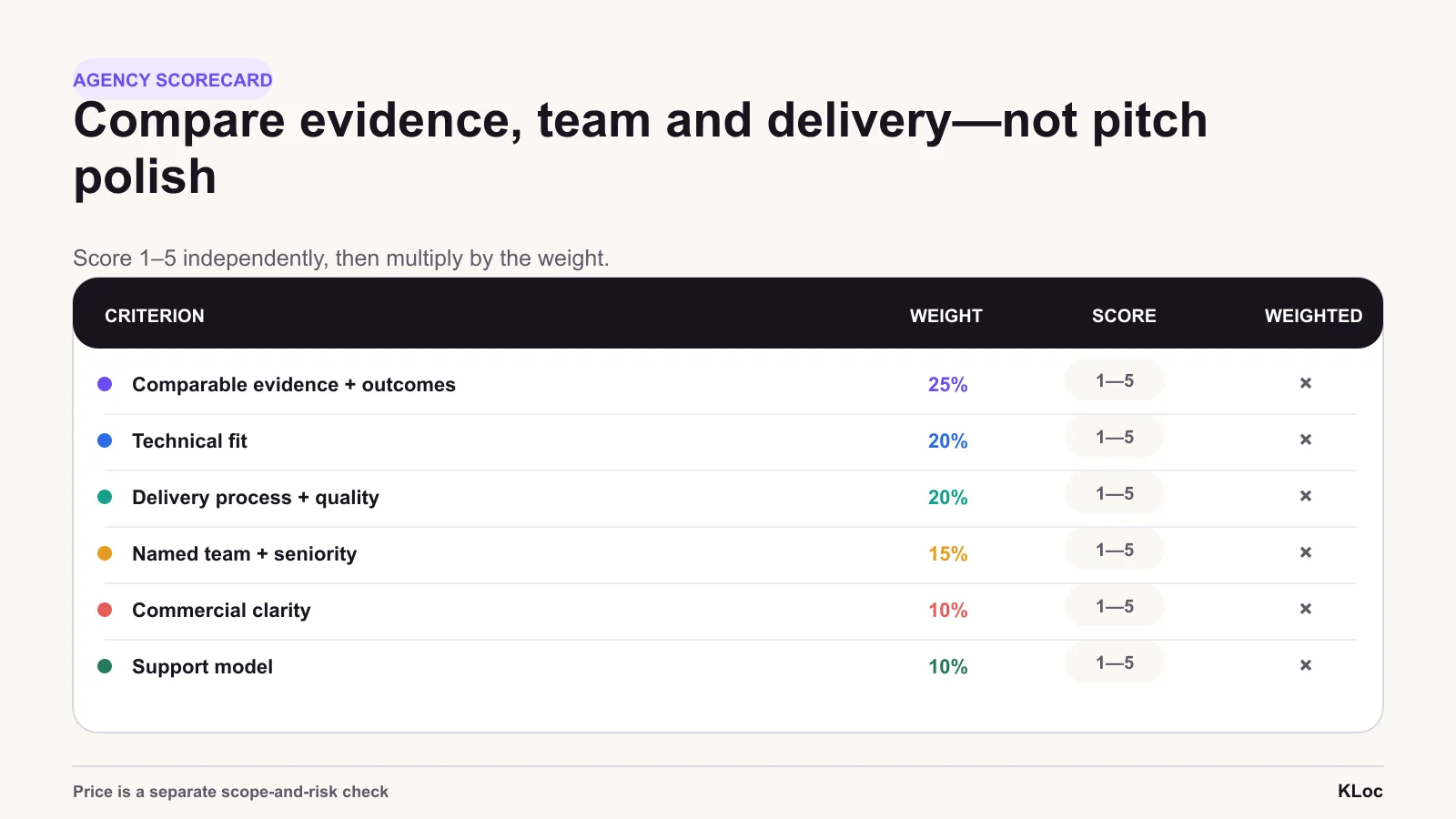
Weighted scorecard
A weighted scorecard makes assumptions visible. Keep the weights editable and require evidence for every high score.
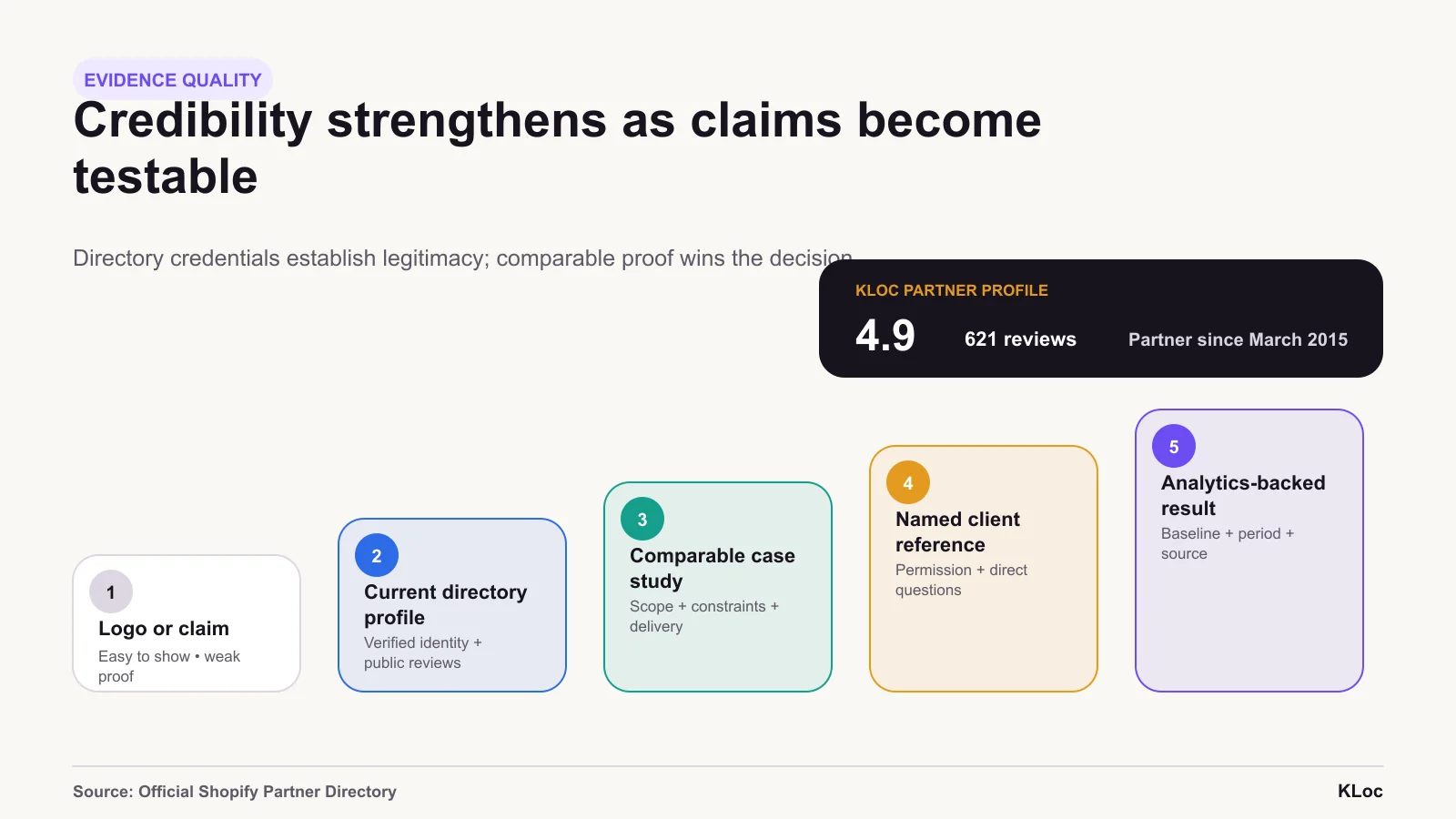
Evidence over credentials
Directory credentials help establish legitimacy, but they do not replace comparable evidence.
The right team for
the work ahead.
Share the brief, the context, or the challenge. We respond within one business day.
Division 01 · KLOCOM
Commerce Engineering
Shopify Plus builds, migrations, integrations, managed services, and agentic commerce architectures.
Explore KLOCOMDivision 02 · KLOCAPPS
Custom Software
Web and mobile applications, platforms, enterprise integrations, and applied AI products built to last.
Explore KLOCAPPSDivision 03 · KLOCERS
Technology Talent
Senior individual engineers, delivery pods, and embedded engineering teams shaped around your systems and delivery brief.
Explore KLOCERS