

The Storefront Wasn't the Bottleneck: How I Was a Sari Connected Shopify and ERPNext
How an international sustainable-fashion brand brought its storefront, inventory and fulfilment data into one dependable flow.

Executive Summary
How an international sustainable-fashion brand brought its storefront, inventory and fulfilment data into one dependable flow.
First decide which system is right
Before we discussed APIs, we had to settle a less glamorous question: when records conflict, which system wins?
An ecommerce integration can easily create two competing sources of truth. Shopify thinks an item is available. The ERP says it has already been allocated. A fulfilment update exists in one system but has not reached the other. Someone corrects a record manually, only for the next automated sync to overwrite it.
Skip that decision and the connection simply automates the confusion.
We mapped the order journey one step at a time:
A customer places an order in Shopify.
The order is created in ERPNext.
Available inventory is adjusted.
The correct fulfilment workflow is triggered.
Shipment and order-status information returns to Shopify.
The customer receives accurate updates.
At each step, we recorded who owned the data, which way it travelled and what the system should do when an update failed.
Building around the way I Was a Sari works
ERPNext's documented Shopify connector can pull orders into ERPNext and create missing customer or item records. That provides a useful foundation, but real businesses rarely fit perfectly inside a default connector.
I Was a Sari had its own fulfilment logic and operational requirements. KLOC created a live data bridge between Shopify and ERPNext, supported by custom applications and automated workflows designed around the brand's processes.
The work covered the information that could directly affect a customer order:
Product and SKU mapping
Available inventory
New orders
Order-status updates
Fulfilment and shipment information
Cancellations, returns and stock adjustments
For publication, the flow is described at business-record level: Shopify owns the customer-facing order; ERPNext coordinates operational inventory and order handling; fulfilment updates return to Shopify. Private object names, field mappings and timing rules are deliberately not presented as public facts.
A straightforward order tells you very little about an integration. The awkward orders reveal the gaps: a partial fulfilment, a cancellation after allocation, a returned item, a missing SKU, a duplicate webhook or a temporary ERP outage.
Each case needs a rule. The system must know when to retry, alert someone, quarantine the record or reverse an earlier action. Without that logic, clean-looking automation can hide an error until a customer finds it.
A practical exception pattern is a duplicate order webhook: check an idempotency key, ignore an already-processed event, log the decision and alert an owner only if the order state is inconsistent. This is an illustrative control pattern, not a claim about a specific incident.
What the team felt after launch
The first benefit was not a prettier storefront. Customers never saw the ERP dashboard or an integration log. They noticed more reliable availability, cleaner order handling and more consistent fulfilment information.
Behind the scenes, the team spent less time moving information between systems and reconciling mismatched records. That left more room for product development, artisan support, merchandising and the brand's own storytelling.
The public case study makes a qualitative claim: a shared operating flow reduced dependence on manual handoffs. It does not attach numerical improvement without client-approved analytics. The recommended scorecard is order-sync success, inventory-update latency, quarantined records, oversells, cancellations and manual interventions.
Inventory problems become expensive when storefront availability, warehouse stock and operational records disagree. An integration does not make the data accurate by itself; it makes ownership, timing and exceptions visible enough to manage. The right measures are merchant-specific: order-sync success, inventory-update latency, quarantined records, oversells and cancellations.
The part that mattered most
The code mattered, but the agreement about ownership mattered more.
Which system owns inventory? Where is an order first considered final? How quickly does fulfilment information need to travel? Who is alerted when a sync fails? What happens when a person makes a manual change?
With clear answers, the integration can enforce the process. Without them, even expensive automation creates more manual work.
I Was a Sari had reached the point where the storefront could no longer operate separately from the rest of the business. Connecting Shopify and ERPNext gave the team a more reliable way to handle new layers of operational complexity instead of pushing them into spreadsheets and manual checks.
If your back office is working harder than your storefront, KLOC can map the Shopify, ERP, inventory and fulfilment flows before recommending an integration.
Source: ERPNext Shopify integration documentation.
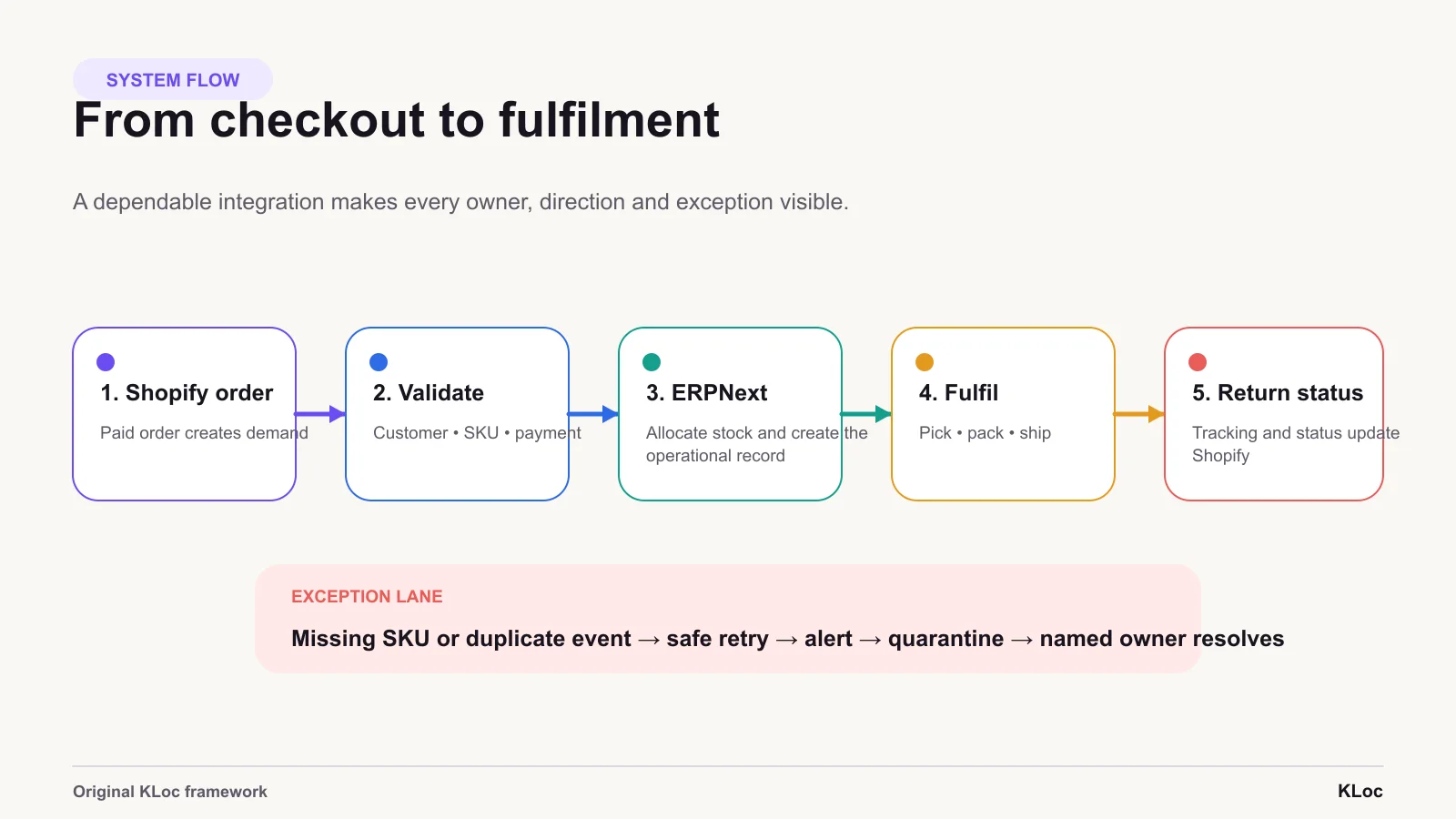
Exception handling
A reliable integration defines the owner, direction and timing of every record, then gives failed or ambiguous events a controlled route.
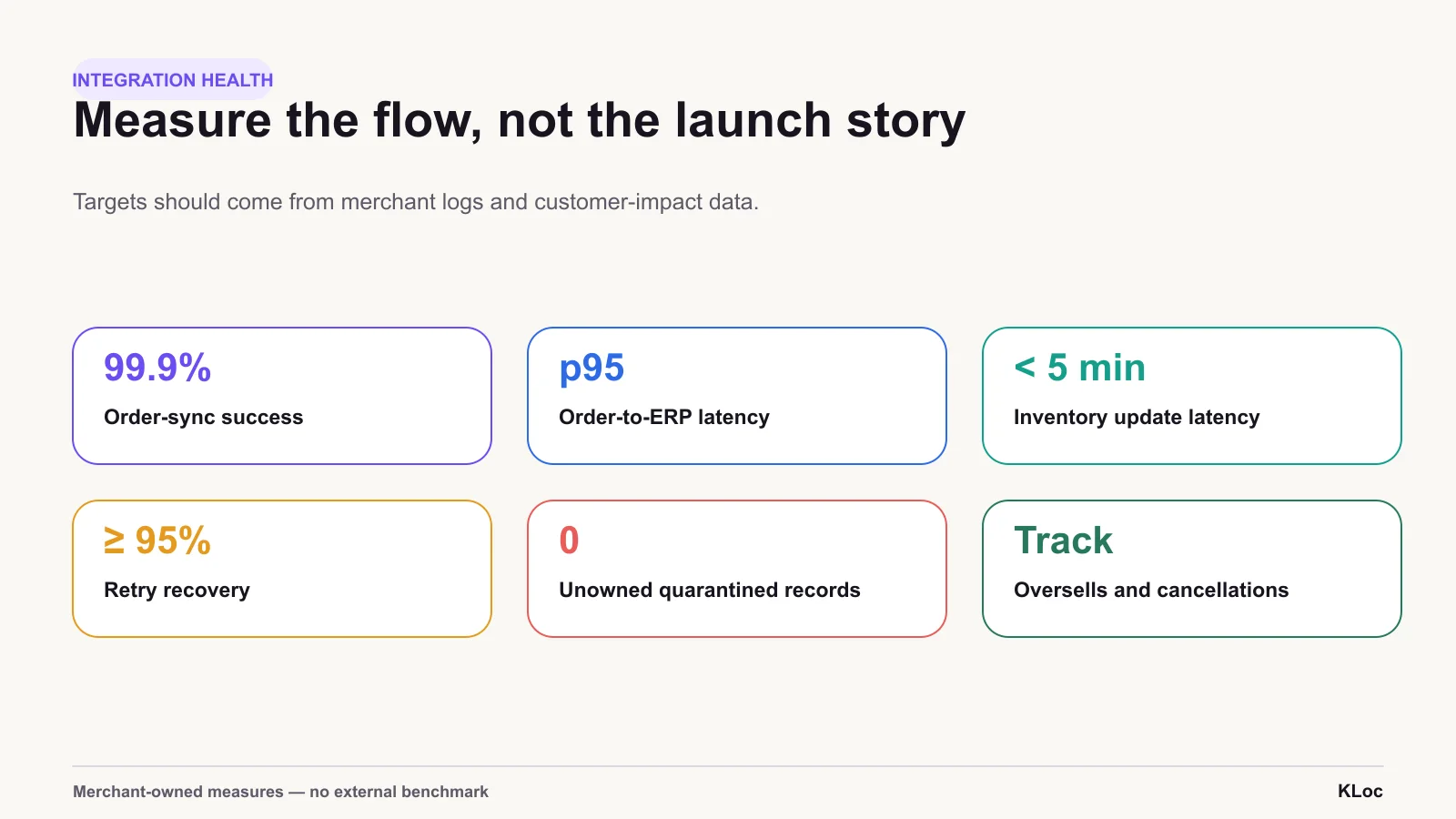
Operating measures
Measure the integration with your own event logs and customer-impact data. These are operating measures, not an external benchmark.
The right team for
the work ahead.
Share the brief, the context, or the challenge. We respond within one business day.
Division 01 · KLOCOM
Commerce Engineering
Shopify Plus builds, migrations, integrations, managed services, and agentic commerce architectures.
Explore KLOCOMDivision 02 · KLOCAPPS
Custom Software
Web and mobile applications, platforms, enterprise integrations, and applied AI products built to last.
Explore KLOCAPPSDivision 03 · KLOCERS
Technology Talent
Senior individual engineers, delivery pods, and embedded engineering teams shaped around your systems and delivery brief.
Explore KLOCERS