

How Lifespark Turned a Sensitive Health Purchase into a Guided Shopify Journey
How clearer product education, privacy information, and human support reduced uncertainty in a sensitive purchase journey.

Executive Summary
How clearer product education, privacy information, and human support reduced uncertainty in a sensitive purchase journey.
Buying a health product online can already feel a little strange. Buying something related to reproductive health? Even more so. Luckily the internet makes it a little less awkward but then you have more questions than answers.
You may not understand half the terminology, you may not be ready to speak to someone and you definitely do not want a website throwing three product cards at you and expecting you to figure out the rest.
That was the main problem with Lifespark's Shopify journey. The store needed to explain their main product offerings which were SeedCheck, SeedBoost and the Accelerator programme, then help customers understand where they should start without quietly making the decision for them.
A normal product grid was never going to be enough here.
Trust comes before the product
Brands in the medical/health space already fight an uphill battle when it comes to building trust. Customers are looking at clinical claims, privacy, expert involvement, discreet delivery, reviews, returns and support before they even start thinking about price.
The website needed to clearly explain what each product was, what it was intended for and what approved evidence supported any scientific or regulatory claims. It also needed to show where general education stopped and medical advice began, because that line can get blurry very quickly when a website is trying too hard to sell something, and honestly can come off looking like a hard sell scam most times.
Privacy is another concern that needed the same attention. Customers had to understand what information was being collected, why it was needed, how it would be handled and who could access it. Honestly, privacy is such a concern as of late. Many customers don’t even complete sign up forms or purchases because they can’t trust a business with their data anymore, and more so now with the advent of ai. Discreet fulfilment, returns, guarantees and access to human support also had to be easy to find.
You can have the cleanest website in the world, but a nice design cannot make up for missing evidence. A trust badge is only useful when the customer understands what it means and can verify the claim behind it. Otherwise, it is just another logo on the page asking people to trust it.
And to be very clear, this article does not make any diagnosis, treatment, clinical accuracy, FDA or CE claim. Any regulated claim needs approved primary evidence, an exact product scope and review from the client's compliance owner.
The products also needed to make sense as a range. SeedCheck, SeedBoost and Accelerator could not feel like three unrelated products that happened to sit next to each other.
Each product represented a different need or stage. Someone may want to understand their baseline, someone else may be supporting an ongoing goal and another customer may need a more complete protocol.
Does that mean the most expensive option is automatically the best one?
Not necessarily.
The catalogue needed to explain who each product was for, who it was not for and when professional advice might be more useful than buying something online. The purpose of the product structure was to make the choice clearer, not push everyone towards the highest priced option.
The quiz had to earn every question
The recommendation quiz needed to answer one simple question:
Where should I begin?
Simple question, but the flow behind it was not as simple. Every question had to change the recommendation, increase confidence in the result or prevent the quiz from suggesting an unsuitable product.
If removing a question did not change anything, there was no real reason to ask it.
The flow started by understanding the customer's goal or current stage. It then asked only for information that affected the recommendation logic. If the information was sensitive, the customer needed to know exactly why the quiz was requesting it.
The full flow looked like this:
Understand the customer's goal or current stage.
Ask only for information needed by the recommendation logic.
Explain why sensitive information is being requested.
Show progress so the quiz does not feel endless.
Recommend a product or bundle and explain why it fits.
Connect the recommendation to Shopify cart and checkout.
Provide another route when the quiz cannot responsibly recommend something.
The public case study explains the customer experience without publishing Lifespark's private recommendation logic. Behind the scenes, every question still needs documentation covering why it exists, which recommendation it affects, how consent works, how long the information is stored, who can access it and how the customer can request deletion or speak to someone.
The recommendation page was equally important. Giving someone a product name at the end of a quiz does not really help if they have no idea how the quiz reached that answer.
The page needed to reflect the customer's responses, explain why the product fit and allow them to review the evidence before buying. Without that explanation, personalisation can start to feel less helpful and a lot more like the store collected personal information just to throw a product back at you.
McKinsey found that 71% of consumers expect personalised interactions and 76% become frustrated when they do not receive them. It also found that personalised content made 78% of consumers more likely to repurchase.
These figures show that customers value relevant experiences. They do not mean that adding a quiz to a website will magically improve conversion. A bad recommendation is still a bad recommendation, regardless of how much information the customer entered to get it.
What happens after checkout?
A lot of ecommerce journeys collect useful information before the purchase and then completely forget about it once the order is placed.
For health and wellness products, that can become a bigger problem because customers may need setup instructions, reminders, educational material, replenishment support or help using the product responsibly over time.
Someone who bought a baseline test needs a different next message from someone starting a supplement subscription. Sending both customers the same generic email flow wastes the context collected during the quiz.
Any post purchase communication also needs to stay within the approved product claims. The customer should receive useful guidance without the brand making health promises it cannot support.
Measure the whole journey
A high quiz completion rate can paint a very pretty but misleading picture if the recommendations are still irrelevant.
The full journey needs to be measured:
Quiz start → completion → recommendation view → product click → add to cart → purchase → repeat purchase
Drop off by question is equally useful. If customers keep leaving at the same point, the question may be confusing, intrusive or simply unnecessary.
No quiz conversion or health outcome is being claimed here without approved analytics. The useful product metrics are quiz completion, recommendation to cart rate and checkout conversion. Clinical and health outcomes need to be measured and reported separately.
The purpose of guided selling in a category like this is to give someone enough information to make a sensible choice. Sometimes that choice will be a product. Sometimes it will be speaking to a professional or deciding that buying is not the right next step.
For brands that need to educate customers before asking them to buy, KLOC can help structure the catalogue, recommendation logic and Shopify journey without turning a sensitive decision into another generic ecommerce funnel.
Sources: McKinsey's personalisation research, Edelman's 2025 Trust and Health study, and Lifespark's current SeedCheck page.
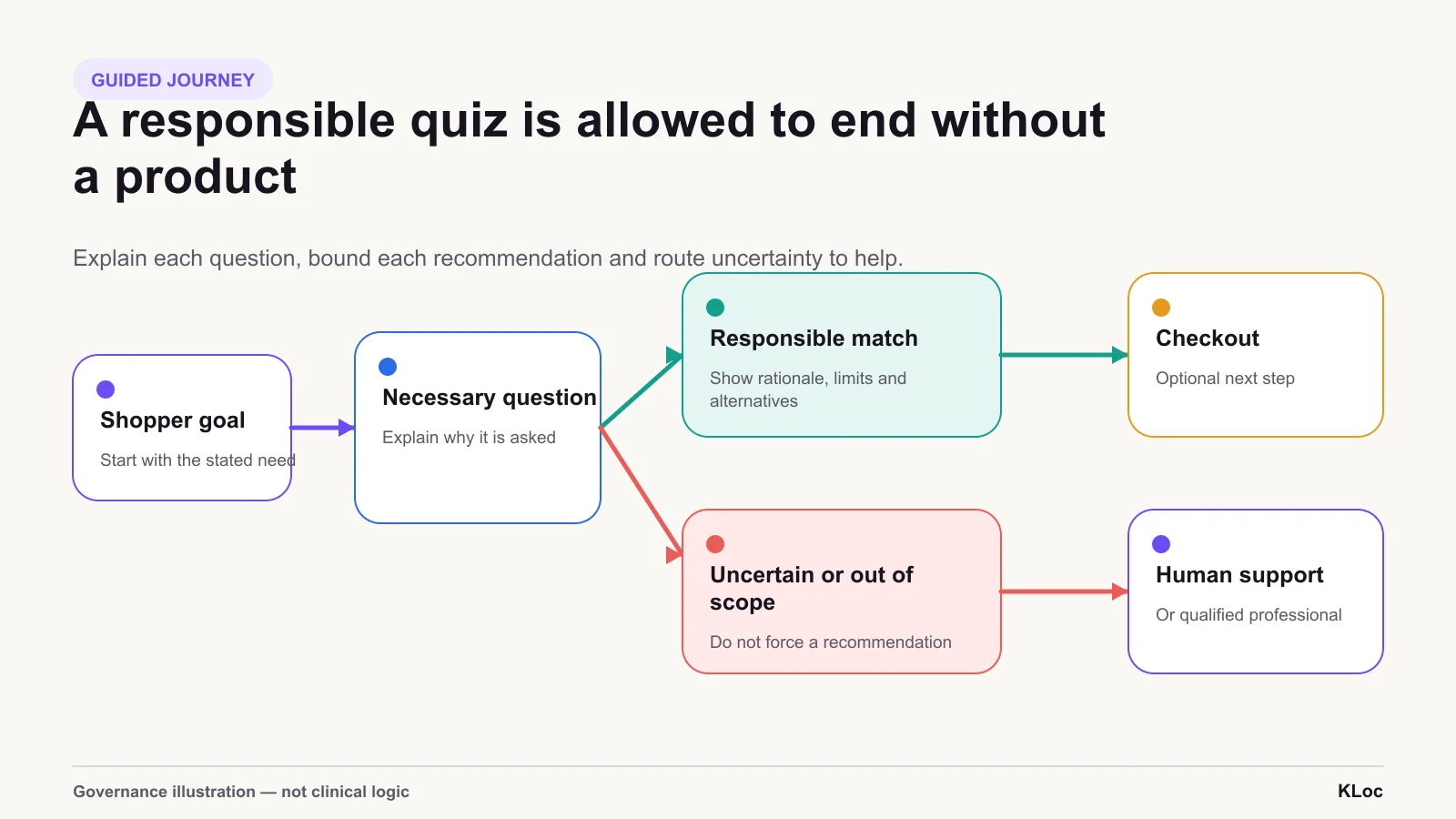
Safe recommendation path
The safe path is allowed to end without a product recommendation. The published diagram illustrates governance, not Lifespark confidential rules or medical decision logic.
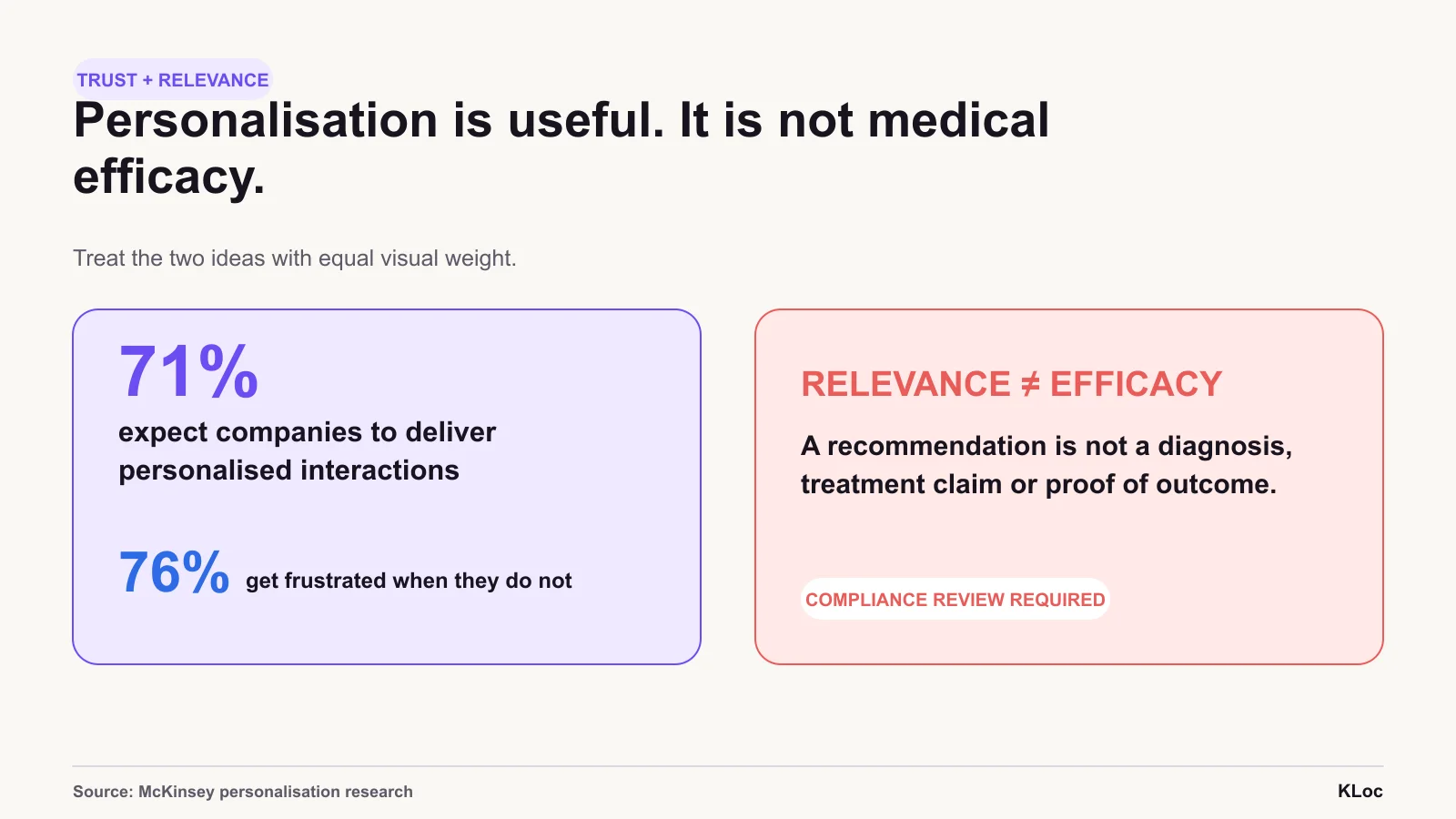
Trust signals
Personalisation can make a journey feel more useful, but it does not turn a recommendation into a medical claim.
The right team for
the work ahead.
Share the brief, the context, or the challenge. We respond within one business day.
Division 01 · KLOCOM
Commerce Engineering
Shopify Plus builds, migrations, integrations, managed services, and agentic commerce architectures.
Explore KLOCOMDivision 02 · KLOCAPPS
Custom Software
Web and mobile applications, platforms, enterprise integrations, and applied AI products built to last.
Explore KLOCAPPSDivision 03 · KLOCERS
Technology Talent
Senior individual engineers, delivery pods, and embedded engineering teams shaped around your systems and delivery brief.
Explore KLOCERS