

Shopify vs Shopify Plus in 2026: Run the Numbers Before You Upgrade
Choose the plan by the operational value it creates, not by prestige or an arbitrary revenue milestone.

Executive Summary
Choose the plan by the operational value it creates, not by prestige or an arbitrary revenue milestone.
The short version
Stay on a standard Shopify plan while it supports the customer experience and operating model you need.
Evaluate Plus when you can identify:
A capability you genuinely require
A measurable commercial or operational benefit
A realistic plan for implementing that capability
Enough value to exceed the additional platform and delivery cost
Paying for Plus without adopting its relevant features is simply a more expensive subscription.
What Shopify Plus costs
Shopify publishes localized Plus pricing by billing currency. For stores billed in USD, standard pricing starts at:
$2,300 USD per month on a three-year term
$2,500 USD per month on a one-year term
That creates a base annual platform cost of $27,600 or $30,000 before implementation, apps, themes and any variable fee that may apply to a more complex or higher-volume business.
The useful comparison is not Plus price versus the price of one standard Shopify plan. It is Plus price versus the complete cost and value of the alternative: plans, transaction fees, separate stores, applications, manual work and capabilities the business cannot currently provide.
When Shopify Plus may earn its keep
1. Checkout requirements create measurable value
Plus provides deeper checkout extensibility, including access to advanced branding and extension capabilities. The business case might involve delivery or payment logic, high-value upsells, B2B/D2C differences or operational rules that cannot be handled adequately on the existing plan.
A more branded checkout does not justify the upgrade on its own. The requirement should connect to conversion, compliance, operational accuracy or customer experience.
2. B2B complexity exceeds standard-plan limits
Shopify B2B is no longer exclusive to Plus. Basic, Grow and Advanced stores can use companies, locations, catalogues, payment terms and other B2B features.
Plus becomes relevant when the business needs capabilities such as unlimited B2B market catalogues, catalogues assigned directly to individual companies or locations, and advanced payment options including deposits and partial payments.
Needing B2B is no longer enough reason to upgrade. Hundreds of customer-specific catalogues and advanced payment workflows make a much clearer case.
3. One brand operates several regional or specialist stores
Shopify Plus includes one main store and up to nine expansion stores under the standard contract.
Expansion stores can support regional, B2B, employee or physical-retail use cases, but they are not automatically synchronised copies. Shopify states that their products, collections, inventory and settings remain independent unless another system or integration synchronises them. Applications are generally billed per store, and production stores require their own theme licences.
The operational model needs to be designed before the extra stores are created.
4. Administration, security or volume has become enterprise work
Larger organisations may need centralised user management, organisation-level roles, additional security controls, advanced analytics, staging environments, priority support or higher operational limits.
These capabilities can save meaningful time and reduce risk when dozens of people, markets and systems are involved. They create far less value for a small team operating one straightforward store.
Four weak reasons to upgrade
"We crossed a revenue threshold"
Revenue is context, not a requirement. Consider margins, order profile, team structure and operating complexity.
"Serious brands use Plus"
Customers cannot see the plan badge. They experience the product, content, speed, service and checkout.
"We need more product variants"
Shopify supports up to 2,048 variants per product across plans. A daily upload limit of 10,000 new variants can begin once a store has 500,000 or more variants; Plus stores are exempt. The ordinary per-product variant allowance is not a Plus-only feature.
"Our store is slow"
Theme code, media, applications and third-party scripts commonly create storefront performance problems. Upgrading the plan does not repair poor implementation.
A break-even calculation you can use
Estimate the annual value of Plus using:
Labour saved + applications retired + fee savings + incremental gross profit + avoided operational risk
Then subtract:
Additional platform cost + implementation + extra app/store costs + ongoing maintenance
Use gross profit, not revenue, when estimating conversion or sales upside.
For example, suppose Plus and its implementation create an additional first-year cost of $45,000. If the business expects $20,000 in annual labour and tool savings, Plus still needs to create or protect more than $25,000 in gross profit before the case becomes positive. Add a margin of safety because forecasts are uncertain.
How the decision might play out
A fast-growing D2C brand with one market and a conventional checkout: Advanced may still be sufficient, even at substantial revenue.
A hybrid D2C/B2B business with company-specific pricing, deposits and complex catalogues: Plus deserves a detailed evaluation.
One brand operating regional stores with a large team and central governance requirements: The included expansion stores and organisation controls may make Plus operationally valuable.
The decision in one sentence
Shopify Plus is useful when the business can point to a costly limitation that the plan will solve. Treating the upgrade as a growth milestone wastes money.
Identify the constraint, quantify its cost and confirm how the relevant Plus capability will be implemented. If that logic is clear, the plan decision usually becomes much easier.
KLOC can compare the current operating cost and requirements with the Shopify Plus capabilities the business expects to use.
Sources: Shopify Plus pricing, Shopify B2B plan comparison, expansion-store documentation, and variant limits.
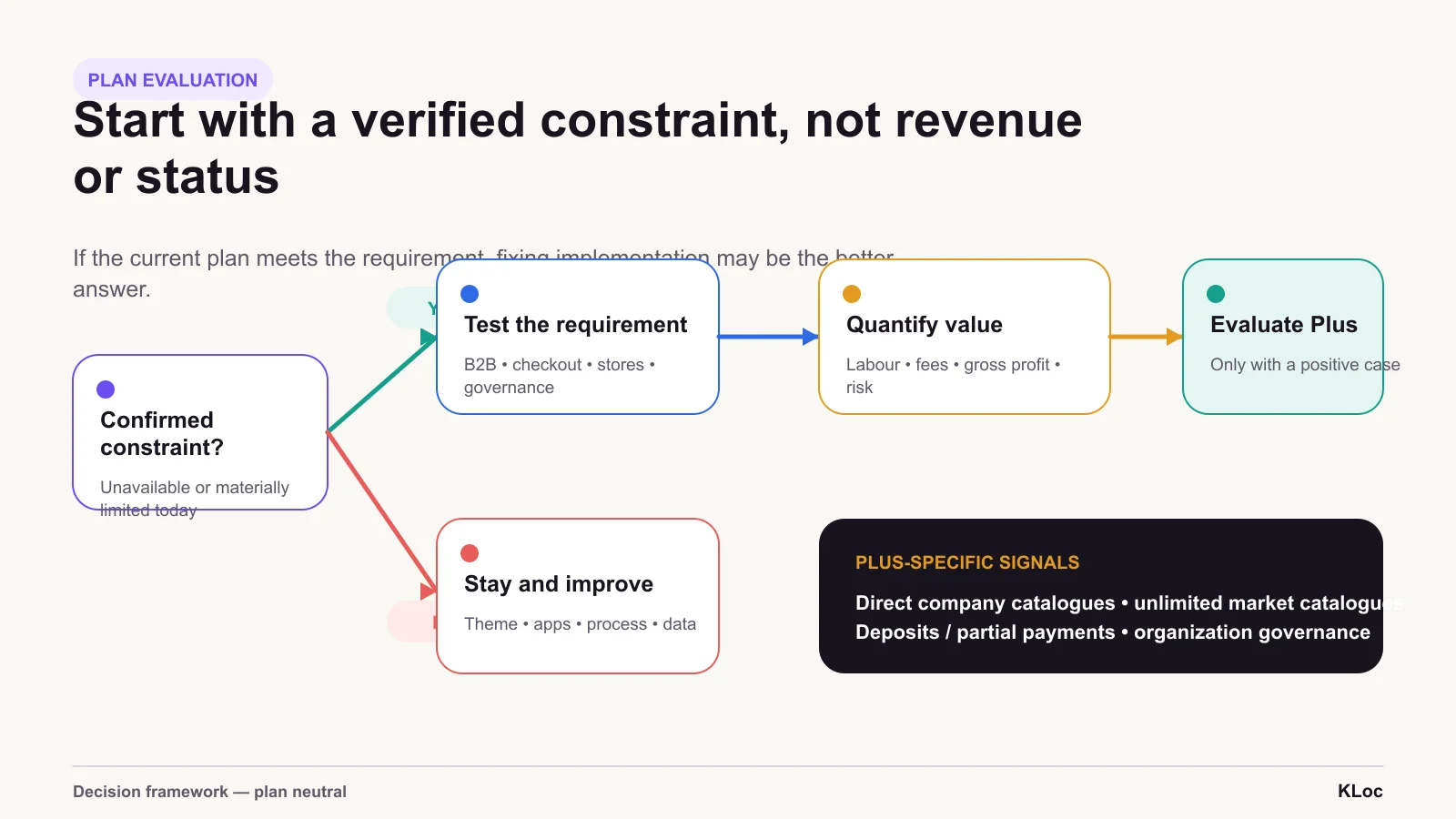
Constraint first
The decision starts with a verified constraint, not revenue or status. When standard plans can meet the requirement, the responsible answer may be not to upgrade.
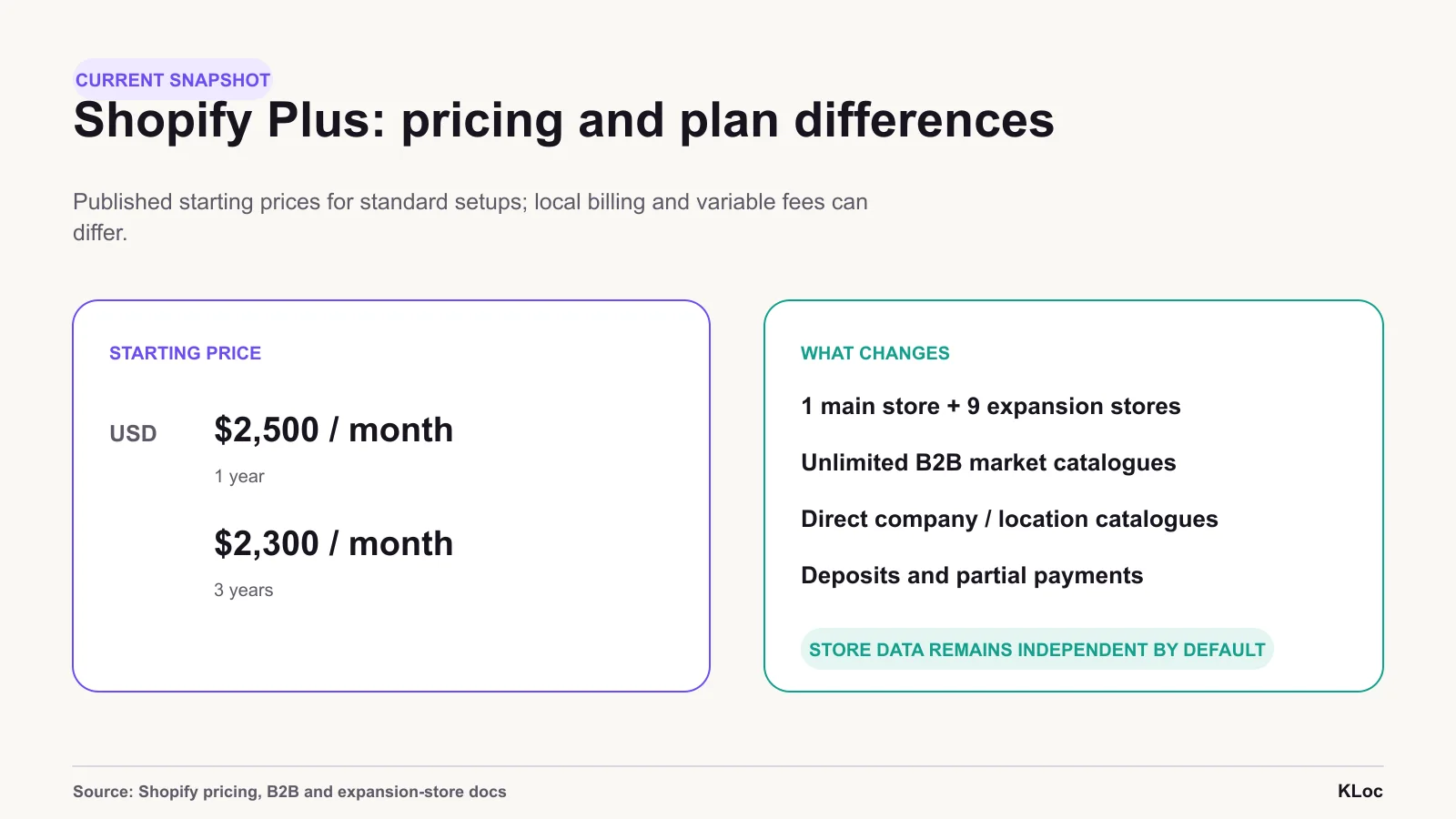
Plan evidence
Shopify pricing, B2B and expansion-store documentation should anchor the feature and cost comparison.
The right team for
the work ahead.
Share the brief, the context, or the challenge. We respond within one business day.
Division 01 · KLOCOM
Commerce Engineering
Shopify Plus builds, migrations, integrations, managed services, and agentic commerce architectures.
Explore KLOCOMDivision 02 · KLOCAPPS
Custom Software
Web and mobile applications, platforms, enterprise integrations, and applied AI products built to last.
Explore KLOCAPPSDivision 03 · KLOCERS
Technology Talent
Senior individual engineers, delivery pods, and embedded engineering teams shaped around your systems and delivery brief.
Explore KLOCERS